
If the idea of spending hours on a machine that isolates just one muscle sounds boring, or if your goal isn’t just to look strong but to be strong, then you’re in the right place.
Welcome to the world of functional strength training.
Whether you want to carry your groceries up three flights of stairs without getting winded, play with your kids in the yard, or simply get out of a low chair with ease, functional strength is the key.
And the best part? You don’t need to hit the gym to be strong.
What is functional strength training?
As its name suggests, functional strength training is a form of exercise that focuses on training your overall body for everyday movements, not just isolating a few muscles. The truth is that it might make you look stronger, but it doesn’t make you stronger.
Instead of working one muscle at a time, like a bicep or abs, functional exercises train multiple muscles and joints together. These movements often mimic daily activities such as
- Squatting down to pick something up
- Reaching overhead to grab an item from a shelf
- Carrying groceries or luggage
- Twisting while moving or lifting
Functional training strengthens these daily natural moving patterns and helps you improve balance, coordination, mobility, and overall strength.
Why does functional strength training matter these days?
Sitting in a car for two hours and climbing up the stairs without your legs screaming, you know what I mean? That’s the exact situation functional strength training prepares you for. Our daily lives today are strangely very inactive. We spend hours sitting at that one desk, and then out of nowhere, our bodies are expected to perform. Lift something heavy. Carry groceries. Run after a train Bend down to grab something that fell under the couch.
The problem is, most traditional workouts don’t really train you for those moments. But how does functional strength training help?
It Improves Your Everyday Movement: So, what functional exercises do is they train you for your daily life’s natural movements, which means your workouts directly improve daily activities like lifting, bending, walking, and climbing stairs.
It reduces the risk of injury: By strengthening your muscles and improving coordination, functional training helps protect your joints and muscles during everyday tasks.
Builds Core Stability: Most functional exercises require your core to stabilize your body. Over time, this strengthens your abdominals, lower back, and hips, improving posture and balance.
Increase mobility and functionality: since these exercises involve full-body movement, they help in increasing the mobility and functionality in the individual’s body, which helps you maintain and improve the range of motion.
It saves your time: Functional strength workouts often involve compound exercises, meaning multiple muscle groups work at once. You don’t have separate time for different muscles. This makes workouts efficient and effective.
Functional strength training you can begin with:
- Bodyweight squats: Squats train your leg muscles, core, and glutes. which is very important for daily moments in daily life. To perform bodyweight squats, stand on your feet, shoulders wide apart, push your hip back like you are sitting on a chair, and bend your hips down in a straight angle.
- Push-ups: push-ups train the chest muscles, shoulders, arms, and core all together. A strong core helps in so many daily life activities, like bending. But if you are a beginner, a complete push-up might look difficult, so start with incline push-ups against a wall or a bench.
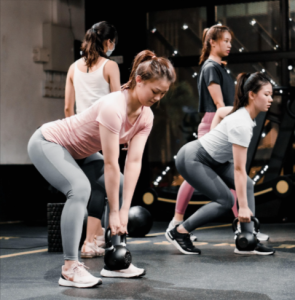
- Deadlifting: Deadlifting is excellent for posterior chain activation. If you are a beginner, you can start with a kettlebell. Or a weight that suits you. Although it is important that you don’t use heavy weights right from the beginning. This is where working as a personal fitness trainer can really help you.
- Farmer’s carry: This is the most practical form of the functional trainer; to do this, simply stand tall with your shoulders back and hold dumbbells in your hands, and then walk forward slowly while keeping your core tight.
- Resistance band rows: This exercise elevates our pulling movement. It strengthens your upper back and shoulders. To do this exercise, attach a resistance band to a stable point, hold the band with both your hands, and start pulling, and then slowly release.
Conclusion
Here’s the verdict: functional training isn’t about having a charming, good-looking body, although that is a bonus, but functional training builds strength for your daily life activities. When you train movements like squatting, lifting, pushing, pulling, and carrying, you’re preparing your body for the small but constant demands of daily living. Things like climbing stairs, bending to pick something up, and carrying grocery bags.
Over time, these improvements add up. You simply have more energy to get through the day.
FAQs: frequently asked questions
Ques 1. I’m in my 50s. Is it too late to start?
Ans. Not at all. This is exactly when it matters most. Functional training preserves mobility and rebuilds the strength you thought was gone. Start slow, stay consistent.
Ques 2. Will functional training help me lose weight?
Ans. Not really, but a little indirectly. Let me tell you how. Building muscle boosts your metabolism. Compound movements burn more calories than isolation exercises. So when you train your functional strength, combined with good nutrition, it works for weight loss as well.
Ques 3. How long do I have to wait to see results?
Ans. You’ll notice everyday tasks feel easier in just weeks. But if you stay consistent, those small wins can add up fast. Remember, real transformation takes consistency.