
Osteoporosis affects thousands of adults here in the Nashville area, yet many people don’t realize how much can be done to protect and rebuild bone strength. Targeted nutrition, smart supplementation, and proper weight-bearing exercise can prevent or even reverse bone loss. Relying only on calcium supplements and bisphosphonate drugs (like Fossamax and Reclast) isn’t enough – healthy bones require protein, micronutrients, and mechanical loading to grow strong and resilient.
In this guide, we’ll break down how vitamins like D3 and K2 support mineral uptake, how magnesium and trace minerals strengthen the bone matrix, and which forms of calcium your body can actually use. We’ll also explore which types of exercise have the greatest impact on bone density, and how the right approach can help prevent fractures, slow bone loss, and assist in restoring bone health over time.
Core mineral structure: what actually makes up bone
- The bulk of bone’s content is a crystalline mineral called Hydroxyapatite (HA), Ca₁₀(PO₄)₆(OH)₂. That means calcium (Ca) and phosphate (P) are the primary building blocks of bone mineral.
- Hydroxyapatite (and the related mineral salts in bone) is what gives bone its compressive strength — its ability to resist crushing and carry weight.
- The rest of bone tissue consists of an organic matrix, mainly type I collagen, which provides tensile strength and flexibility, and non-collagenous proteins (e.g., proteins that underlie mineralization, regulate remodeling, or anchor cells).
Reference article: Linus Pauling Institute
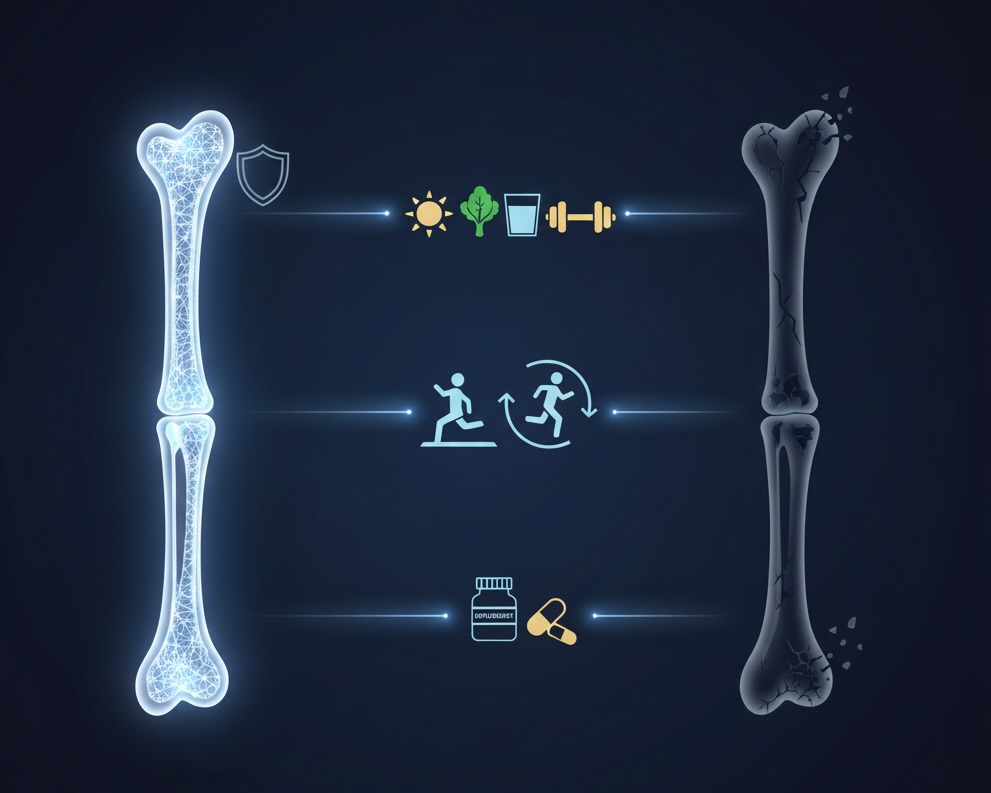
Beyond calcium and phosphate, smaller amounts of magnesium (Mg), sodium (Na), potassium (K), and citrate ions are incorporated into the bone mineral matrix. These influence the crystal size, geometry, and solubility of HA, which in turn affects bone strength, resilience, and metabolic behavior.
Summary: Bone is made of primarily calcium and phosphorus, but other nutrients (or lack of these nutrients) affect bone density and strength.
Calcium and Vitamin D: The Cornerstone Supplements for Bone Strength
Calcium is often treated as the centerpiece of osteoporosis prevention, but supplemental calcium by itself does not build bone. Bone is a living, dynamic tissue composed not just of minerals, but also collagen, enzymes, and hormonal regulators.
Without the additional nutrients that allow calcium to be absorbed, activated, transported, and laid correctly into the bone matrix, supplemental calcium may not significantly improve bone strength or fracture resistance.
This is why many calcium-only interventions have shown limited success — or even increased cardiovascular calcification risk — when not combined with magnesium, vitamin D3, vitamin K2, and adequate protein.
The form of calcium matters as well. Calcium carbonate, the most common and inexpensive supplement, contains a high percentage of elemental calcium, but it requires strong stomach acid for absorption. Individuals with low stomach acid (a common condition in older adults, those on PPIs, or those who eat low-protein diets) may absorb carbonate poorly. Calcium citrate, by contrast, is more bioavailable and does not require as much gastric acidity, making it easier to absorb for many people. Other forms such as calcium hydroxyapatite or calcium malate have different absorption profiles, but the larger principle remains — absorption varies by form, and higher ingestion does not always equal higher utilization.
Even more crucial is the nutrient network that determines whether calcium is directed into bone or misplaced into soft tissue. Vitamin D3 increases intestinal calcium uptake, vitamin K2 activates osteocalcin so calcium binds into the matrix rather than arteries, and magnesium regulates both vitamin D metabolism and hydroxyapatite crystal structure. Trace elements like zinc, copper, manganese, silicon, and boron participate in collagen cross-linking and mineralization enzymes, while adequate dietary protein supplies the amino acids that form the collagen backbone of bone. In this context, calcium becomes one member of a coordinated metabolic team — necessary, but insufficient alone. Strong bones require not just density, but quality, elasticity, and cellular signaling, all of which depend on the nutrient environment that surrounds calcium.
Summary: Calcium is a primary building block of bone tissue, but the form of calcium supplement you take is important. Also vital to bone growth are Vitamin D, Vitamin K2, and other trace minerals.
What kind of calcium supplement should I use?
Here are five common calcium supplement forms, arranged from highest to lowest bioavailability under typical physiological conditions. (Bioavailability varies by stomach acidity, age, gut health, and co-nutrient status — but this ranking reflects general absorption efficiency supported by comparative studies, so don’t send me emails about this.)
- Calcium Citrate — Highly Bioavailable
-
- Absorption: ~35%–40%, often better than carbonate
- Strengths: Absorbs well even with low stomach acid; good for older adults or those on acid-reducing medications.
- Notes: Can be taken with or without food; gentle on digestion.
- Calcium Hydroxyapatite (Microcrystalline or MCHA)
-
- Absorption: Moderate–high; well utilized because it resembles natural bone mineral.
- Strengths: Contains calcium + phosphorus in bone-native ratio; may support collagen matrix interaction.
- Notes: More expensive; often derived from animal bone. Be sure to buy from reputable companies that test well in the lab, because supplements with bone can be contaminated with lead.
- Calcium Malate / Calcium Citrate-Malate (CCM)
-
- Absorption: Moderate, often superior to carbonate and similar to citrate in favorable conditions.
- Strengths: Good solubility; studied in fortified beverages due to high uptake.
- Notes: Useful in low-acid conditions; gentle on GI system.
- Calcium Gluconate
-
- Absorption: Moderate, but low in elemental calcium, so larger doses required.
- Strengths: Useful for people with sensitive digestion.
- Notes: Not as concentration-dense, so tablet count may be high.
- Calcium Carbonate — Lowest Bioavailability
-
- Absorption: ~20%–27% on average, best only when taken with food and adequate stomach acid.
- Strengths: Very high in elemental calcium; inexpensive and widely available.
- Notes: Poor absorption in people with low stomach acid; can cause gas or constipation.
Vitamin D3 (cholecalciferol)
Vitamin D3 is a regulatory hormone—not just a “vitamin”—that directs how the body absorbs and uses calcium. When D3 levels are sufficient, the intestines dramatically increase calcium uptake, the kidneys retain calcium more efficiently, and bone-building osteoblast activity improves. Without enough D3, even high calcium intake does little for bone strength because absorption remains low and bone turnover accelerates. Research consistently links healthy serum 25(OH)D status with reduced fracture risk, improved bone mineral density, and slower age-related bone loss.
Vitamin D3 and vitamin K2 operate as a metabolic partnership. D3 increases circulating calcium, while K2 directs that calcium into bone rather than soft tissue. D3 alone improves density, but D3 + K2 improves matrix quality and reduces arterial calcification risk more effectively than either nutrient alone. This dual-pathway synergy is why many osteoporosis protocols include both nutrients as co-factors rather than stand-alone interventions.
Surprisingly, some new research on vitamin D supplementation for bone loss has revealed an intricate symbiosis between bone signaling and vitamin D. As it turns out, at least in rat models, vitamin D supplementation without mechanical bone loading (weight-bearing exercise) INCREASES bone loss! Yet another reason to pick up the dumbbells in order to keep your bones strong.

Summary
Like vitamin K2, both vitamin D3 and magnesium are upstream regulators of bone construction—not simply passive minerals.
- Vitamin D3 increases calcium availability.
- Magnesium activates vitamin D and supports collagen-matrix construction.
- K2 integrates the calcium into bone and prevents calcification into other tissues.
- Supplementing with vitamin D WITHOUT mechanical loading of the bones (i.e. lifting weights) may make bone loss WORSE.
Together they form a three-leg biochemical foundation for bone strength, improved micro-architecture, and meaningful osteoporosis prevention.
Clinical references:
National Institute of Health office of dietary supplements – Vitamin D Fact Sheet
Cleveland Clinic vitamin D overview
Medscape vitamin D guidelines
Beyond the Basics: Vitamin K2, Magnesium, and Trace Elements for Osteoporosis
Vitamin K2 plays a central role in building and maintaining bone matrix by activating two key proteins: osteocalcin and matrix Gla protein (MGP). Osteocalcin binds calcium and incorporates it into the collagen-based scaffold of bone, while MGP prevents inappropriate calcification in soft tissues. Without adequate K2, these proteins remain inactive, leading to weaker bone architecture and greater fracture risk. Clinical and mechanistic research suggests that sufficient K2 intake improves bone mineralization efficiency, reduces bone loss, and in some cohorts even contributes to partial reversal of osteoporosis through improved micro-architecture rather than simple density gains.
Authoritative vitamin K overview: National Institutes of Health (NIH) Office of Dietary Supplements ,Vitamin K Fact Sheet for Consumers.
K2 occurs in several forms, but MK-4 and MK-7 are the most studied. MK-4 is the form present in animal foods and is also used pharmacologically in Japan at high doses (45 mg/day) for osteoporosis treatment. It has a short half-life—measured in hours—so it reaches peak levels quickly and disappears quickly. MK-7, found largely in fermented foods like natto, has a much longer half-life (up to 2–3 days), allowing for stable blood levels with small daily doses. MK-7 is generally more effective at increasing circulating active osteocalcin at standard supplement doses, but MK-4 has a longer track record in formal therapeutic trials for fracture reduction.
Together, vitamin K2 (especially MK-7 for steady-state supplementation and MK-4 for clinical dosing) and these minerals form an interconnected system that builds strong, flexible bone tissue and helps prevent or partially reverse osteoporosis by improving the quality of the bone matrix—not just the quantity of mineral content.
MK-4 and MK-7 are the specific molecular forms of vitamin K2 that appear in supplements. They are not downstream metabolites you produce after taking “K2”; they are the K2 isoforms themselves.
Vitamin K2 (menaquinones)
Commercial K2 supplements typically contain either isolated MK-7, MK-4, or occasionally a blend. Each isoform behaves differently in the body:
- MK-4 occurs naturally in animal products and certain tissues through conversion of vitamin K1. MK-4 has a short half-life (hours), reaches high peaks quickly, and has been used in Japan at pharmacologic doses for osteoporosis therapy.
- MK-7 (and other long-chain menaquinones) come primarily from bacterial fermentation and foods such as natto. MK-7 has a much longer half-life (2–3 days), reaches steady-state levels with small daily doses, and is more effective at increasing circulating active osteocalcin at typical supplement strengths.
Your body does convert some dietary K1 (phylloquinone) into MK-4 in certain tissues, but that conversion is limited and does not create MK-7. This is why MK-7 supplements are often used to provide stable, long-acting K2 activity.
Magnesium for Osteoporosis
Magnesium is foundational for bone health because it participates in more than 300 enzymatic reactions, many of which regulate calcium transport, vitamin D activation, and bone mineralization. Approximately 50–60% of total body magnesium is stored in skeletal tissue, where it influences crystal size, density, and elasticity. When magnesium is insufficient, the body struggles to convert vitamin D into its active hormonal form (calcitriol), which reduces calcium absorption and accelerates bone resorption. Low magnesium intake is correlated with lower bone mineral density, increased inflammatory signaling, and higher fracture risk—often even when calcium intake is adequate.
Magnesium’s role extends beyond mineral density. It affects collagen matrix formation, PTH (parathyroid hormone) regulation, and hydroxyapatite crystal stability, making bone not only harder, but more resilient and less brittle. Supplemental forms differ in bioavailability—magnesium glycinate, citrate, and malate are generally better absorbed than oxide or carbonate—and consistent daily intake is more effective than large, occasional doses.
Supporting minerals & trace elements for bone formation, remodeling, and maintenance
Bone is not static. iI undergoes continuous remodeling (resorption and formation), and many minerals support the biochemical processes underlying that remodeling. Key ones include:
- Phosphorus is required for hydroxyapatite crystal formation, forming the mineral backbone of bone.
- Zinc, manganese, copper, and boron all participate in collagen synthesis, cross-linking, and enzymatic processes that create resilient bone matrix.
- Silicon (Si): Emerging evidence suggests silicon (or silica) plays a role in the early phases of bone mineralization, possibly enhancing collagen synthesis or acting in matrix mineral deposition.
- Potassium (K): By helping reduce systemic acidity (through buffering), potassium may reduce calcium loss via urine, indirectly supporting better calcium retention for bone.
- Other trace elements: Some studies also mention elements like vanadium, strontium, and trace fluoride as having potential—but less well-established—roles in bone metabolism.
Research background: Bone-health mineral reference
Is boron an important supplement for osteoporosis?
- Boron is considered a trace element that appears to influence mineral metabolism, especially calcium, magnesium, and phosphorus — the main mineral constituents of bone.
- Some animal studies show that boron deficiency leads to poor bone strength, decreased bone volume and trabecular thickness, delayed bone growth/maturation, and reduced bone quality.
- In experimental bone-repair models, incorporating boron into synthetic hydroxyapatite (so-called boron-doped nano-hydroxyapatite) enhanced osteoblast proliferation, differentiation, and mineralization — leading to stronger bone-like tissue formation.
- Mechanistically, boron may also influence hormone metabolism (e.g., estrogen/testosterone), vitamin D activity, and mineral utilization, which in turn affects bone remodeling — though these pathways remain incompletely understood.
Reference article on the effect of boron supplementation on bone growth.
However — important caveat — while boron shows promise, definitive evidence in humans is sparse. Regulatory bodies generally do not classify boron among the essential, bone-specific nutrients (like Ca, P, Mg, vitamin D) because controlled clinical data linking boron intake to bone density or fracture risk remain limited or inconsistent.
Thus, boron’s role is best thought of as supportive/modulatory rather than foundational.
So many minerals — what this means for bone-health strategy
Bone health is complex because bone is not just “mineral.” It’s a composite material — mineral crystals embedded in an organic (protein) scaffold — and needs to be both hard (to bear loads) and flexible (to resist fractures). That composite structure, plus its dynamic remodeling process, demands a broad palette of nutrients:
- The minerals forming hydroxyapatite give compressive strength and stiffness.
- Trace minerals and cofactors support the enzymatic processes that build the organic matrix, regulate mineral deposition, and maintain bone remodeling.
- Some minerals (e.g., magnesium, silicon, boron) influence crystal formation, mineral solubility, collagen-mineral interactions, and hormonal/metabolic regulators of bone turnover.
In practice, this suggests a nutrient-density approach to bone health — ensuring adequate intake not just of calcium and vitamin D, but a broad mix of minerals and cofactors (from a nutrient-dense diet) to support optimal bone matrix formation, remodeling, and resilience.
Finding a Bone Health Specialist in Nashville, TN: What to Look For
When addressing a serious condition like osteoporosis, generalized advice is simply not enough. Residents of Nashville, TN need a local specialist who understands the comprehensive approach to bone health, which extends far beyond basic supplements. Look for a team that includes certified nutrition counselors and trainers with experience in exercise for osteoporosis and osteopenia. Your chosen professional should not only be knowledgeable about high-quality supplements for osteoporosis, but also collaborate with your physician to ensure your plan is safe and effective. If you live in or near 12 South or Green Hills, we’re standing by for you! Drop us a note and we’ll set a time to talk over strategies. Our fearless leader, Dan DeFigio, was featured in MD News on preventing and reversing osteoporosis.

Personalized Supplement Plans: Why Diet-First Coaching is Working So Well in Middle Tennessee
Your goal isn’t just to swallow pills; it’s to create lasting skeletal health. In Middle Tennessee we are fortunate enough to have access to fresh, healthy food. Our approach is always Diet-First Coaching. Supplements are exactly that—supplemental support to a solid nutritional foundation.
A personalized plan means we first analyze your typical weekly dietary intake. Only then do we recommend specific, high-quality products to fill proven deficiencies. This ensures that every step you take is efficient, effective, and tailored to your unique biology, maximizing the benefits of every nutrient for optimal bone density.
Exercise and Supplementation: The Best Weight-Bearing Routine for Bone Density in Green Hills
Supplements alone cannot prevent or reverse osteoporosis; they must be combined with the right exercise.
The best routine focuses on weight-bearing exercise to stimulate bone growth without risking fracture. If you’re searching for personal training in the Green Hills area, look for a trainer who is specifically trained to guide clients with bone density issues. This will likely involve specific strength training exercises with resistance, and possibly the use of whole-body-vibration to stimulate bone growth.
Another add-on to exercise for osteoporosis – for the right clients – is impact training: Hops, jumps, hopscotch, or other light jumping exercise. When appropriate, this kind of training stimulates bone production. In and exercise kinesiology and physiology, it is called “ground reaction force.” GRF stimulates bone growth by creating mechanical stress that triggers bone remodeling. Higher-impact activities like fast walking, jogging, and jumping generate GRF, which puts pressure on the bones, signaling the body to build stronger bone tissue in response.
Combining your tailored supplement plan with supervised, effective resistance exercise is the fastest path to stronger bones and a safer, more active life right here in Nashville!

Summary of the current science (from a practical/“coaching” lens)
- Prioritize calcium, phosphorus, magnesium, vitamin D, and vitamin K2 — they form the core biochemical and structural foundation of bone.
- Include foods rich in trace minerals and supportive cofactors (zinc, copper, manganese, silicon, potassium, boron). Vegetables, fruits, and nuts are the primary dietary sources of these minerals.
- Understand that boron may help, especially in relation to mineral metabolism and bone formation, but treat it as secondary support, not a primary building block.
- Encourage food-based sources over high-dose supplements for trace minerals, because balance matters — bones integrate many elements, and oversupplying isolated trace minerals can be of dubious benefit (or even risk).
- Eat enough protein! Many women with osteoporosis or osteopenia consistently under-eat dietary protein. Adequate protein is essential for maintaining muscle and for giving your bones the collagen material they need for rebuilding.
- Newest research reiterates the need for bone-loading exercise: weight training and/or impact training.